
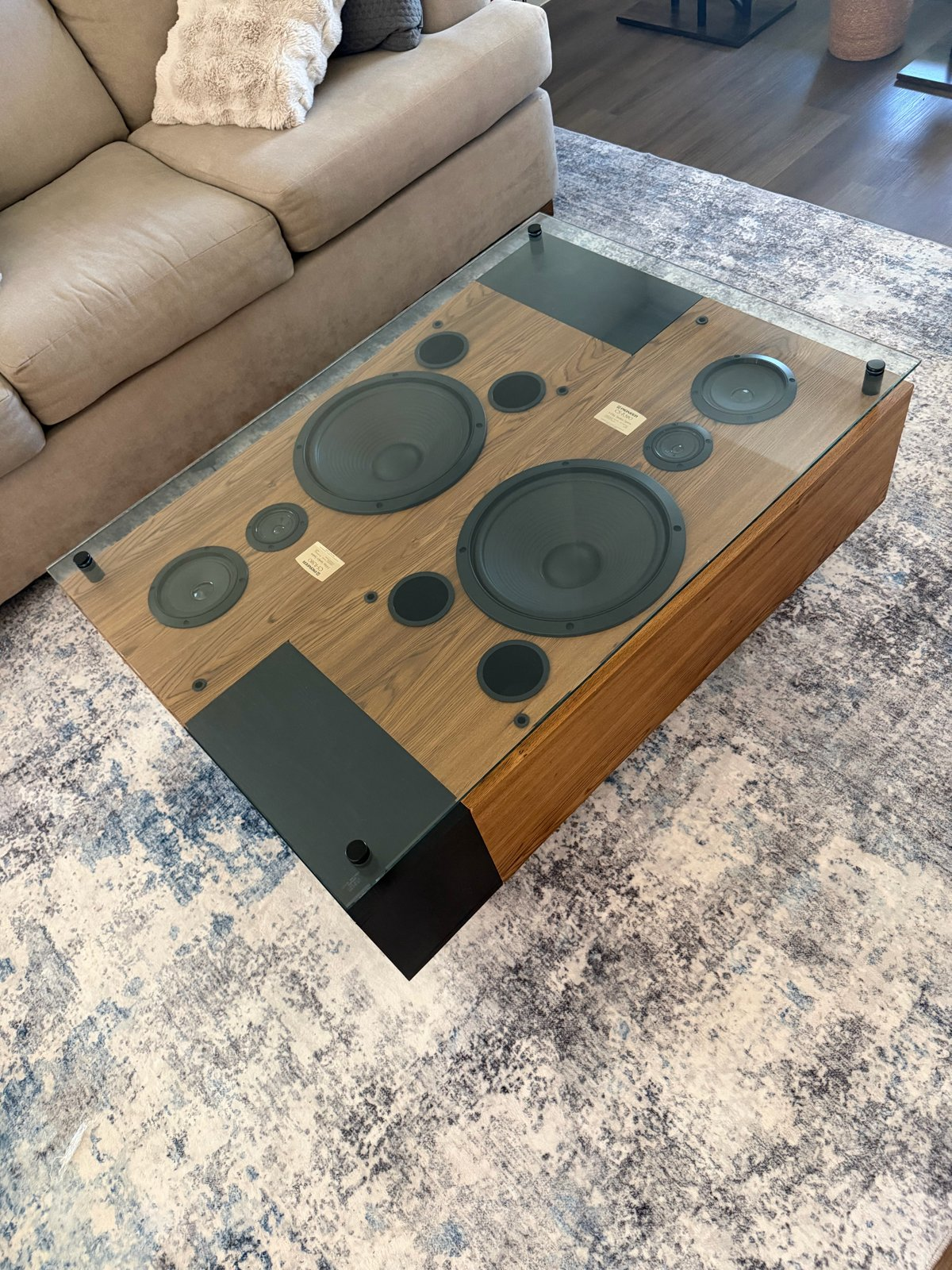

My son saw a similar build on Instagram and wanted a speaker coffee table for his house. It combines a vintage look with real function, and it’s something you can’t just go out and buy. The sound is amazing, and it’s the statement piece he was looking for. You can pair it with your phone or a Roku TV box.
Building the Speaker Coffee Table
It started with a pair of vintage Pioneer CS-R580 tower speakers I bought on Facebook Marketplace. The speakers are super cheap for the quality of sound they put out. When I laid them out, the speakers were about 35″ x 15″ each and made a coffee table that was 35″ x 30″.
Once I had the two speakers together, I wasn’t crazy about it. It looked too square, basically two big boxes pushed together, which is exactly what it was. So I added a couple of shadow boxes to the ends. I built them, along with the base, out of hickory, since I already had it on hand. I painted the hickory black. They break up the shape and make it look more like a piece of furniture and less like speakers lying on the floor. This made the table size 42.5″ x 30″.


Getting the Height Right
The speakers are 10″ thick, and there is a 1.5″ gap between the speaker face and the glass top. That makes for a pretty low table, so I built a custom frame to raise it up to the right height. The frame sits underneath and gives it some additional strength and support. It sits about 6 inches in from the edge, so it’s hard to see. It’s as if the speakers are floating above the floor. This gives the table a finished height of about 18 inches.
Powering It
While the look of the speakers is awesome, the really great part is that they are functional. Speakers like these need an amp to drive them. I went with a Fosi BT20A Bluetooth amp. It’s really small but powerful. It has 100 watts per channel, which is more than what is needed for these speakers. I mounted it right under the front edge of the table with the power switch and control knobs easily accessible. It has RCA inputs, but I just pair my phone to it over Bluetooth.

The Glass Top
For the glass top I used 3/8-inch tempered glass that I had custom ordered from a local glass shop. The first piece was cut wrong and had to be remade, which was frustrating. The holes in the corners for the standoffs were in the wrong place. The guy measured it correctly but switched up which edge was 1.5″ and which edge was 2″. The glass was the most expensive part of the build, and I probably could have gone thinner, but I love the look of it. It sits 1.5″ above the speakers. The standoffs come in a bunch of different sizes and are easy to pick up from Amazon. Two of them use the holes where the speaker grilles used to attach, and I drilled two more holes for the other two.

How it turned out
It’s a coffee table and a stereo in one, and it gives a couple of old speakers a second life. Here it is in the living room, with the open shadow box on the end. It’s fully functional, and it sounds great.

What I’d do differently
If I did it again, I’d build everything from scratch and mount the speakers in a custom-built walnut box. Most of my furniture is walnut, and this would look so nice in walnut instead of MDF speaker boxes with fake wood plastic veneer. I would swap over the ID plate and hardware so it still looks original, just much nicer.
Specs
Amplifier: Fosi BT20A (from Fosi’s user instruction page)
- Output: 100W + 100W at 4Ω
- Inputs: Bluetooth 5.0 and RCA
- Bass and treble controls
- Speaker impedance: 2–8Ω
- Power supply: 24V 4.5A
- Size: 130 x 100 x 35 mm
Speakers: Pioneer CS-R580 (figures other than the model are approximate, as commonly reported in online listings, not from a Pioneer manual)
- 3-way speaker system (per the badges on the speakers)
- Maximum power: about 150 W
- Impedance: about 8 ohms
- Frequency response: about 32 Hz to 20 kHz
- Woofer: 12 inch
- Size as a standing tower: about 35 in high x 15 in wide x 10 in deep
Top
- 3/8-inch tempered glass
- Sits 1.5″ above the speakers
Leave a Reply